 blog
blog
Martial Arts Schools for Kids: What Parents Should Know
Table of Contents
- Why Parents Are Choosing Martial Arts Schools for Kids
- Benefits of Martial Arts for Child Development
- Is Martial Arts Training Worth It for Toddlers?
- What to Look for in a Competition-Free Martial Arts School
- Signs of a Quality Program: Instructor Retention and Curriculum
- Cost, Equipment, and Getting Started
- Conclusion: Finding the Right Fit for Your Child
- Frequently Asked Questions
Last Updated: September 9, 2026
Why Parents Are Choosing Martial Arts Schools for Kids
Parents today face an endless menu of activities, yet many find that traditional sports don't deliver the character development they hoped for. Martial arts schools for kids offer something different: a structured path where physical skills and personal growth develop side by side, not as separate goals. At Great Way Martial Arts, we've seen this transformation unfold daily since 1993.
The shift toward martial arts reflects a broader parenting priority. Beyond winning games or collecting trophies, families want their children to build confidence, self-discipline, and resilience, qualities that research links to long-term success. A recent report from ParticipACTION's physical activity guidelines for children emphasizes that children need daily movement that builds both motor skills and social confidence, which is exactly what a well-designed martial arts program provides.
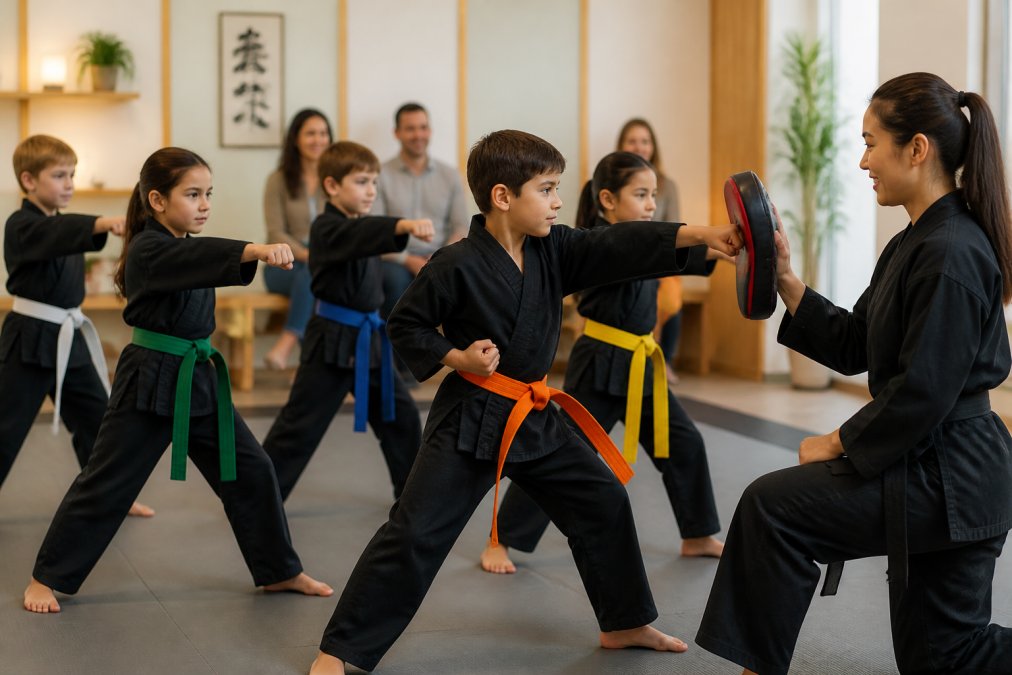
Below, we'll walk through what actually matters when evaluating martial arts schools for your child, from teaching philosophy to costs, so you can make a confident choice.
Benefits of Martial Arts for Child Development
The benefits of martial arts for child development extend far beyond learning kicks and blocks. Regular practice builds physical fitness, coordination, and agility, but the most significant gains often appear in behavior and emotional regulation.
Children who train consistently typically show measurable improvements in several areas that matter at home and school:
- Focus and attention: The structured repetition of techniques trains the brain to concentrate on one task at a time.
- Self-discipline: Progress comes through consistent effort, teaching children that results follow commitment.
- Respect and social skills: Bowing, listening to instructors, and working with partners builds courtesy and cooperation.
- Confidence: Mastering new skills creates genuine self-assurance that carries into the classroom and playground.
What makes martial arts unique is how these traits compound over time. A child who starts with low confidence doesn't just learn to punch; they learn to set goals, work through frustration, and experience the pride of earning each new belt.
Is Martial Arts Training Worth It for Toddlers?
Many parents wonder if martial arts training is worth it for toddlers, particularly children aged three to five. The answer depends on your goals and the program's structure.
For very young children, martial arts is less about learning techniques and more about building foundational skills (peer-reviewed research). A quality preschool program focuses on listening, following directions, balance, and basic motor skills, all delivered through games and short activities that match a young child's attention span. The benefits of martial arts for child development at this age show up as improved coordination and better social interaction with peers.
However, not every child is ready at three. Some toddlers struggle with the structure of a formal class, and pushing too early can create negative associations. A good school will offer a trial class so you can gauge your child's readiness. If your child can follow simple instructions and separate from you without distress, they may be ready to begin. If not, waiting six months and trying again is perfectly reasonable.
What to Look for in a Competition-Free Martial Arts School
For many families, the pressure of tournaments is precisely what they want to avoid. A competition-free martial arts school removes that stress and focuses entirely on personal development. This approach allows children to progress at their own pace without the anxiety of public performance or the disappointment of losing.
In a competition-free environment, the curriculum centers on skill mastery, self-defense, and character building. Children learn that success means beating their personal best, not beating an opponent. This philosophy is particularly valuable for children who are sensitive, neurodivergent, or simply prefer cooperative activities over competitive ones.
The best competition-free programs still maintain high standards. Students should test for belt promotions, but the testing process should be a celebration of growth rather than a stressful event. Ask how the school handles belt testing and whether all students are supported through the process, regardless of how quickly they progress.
Signs of a Quality Program: Instructor Retention and Curriculum
The single strongest indicator of a quality martial arts school is instructor retention. Children bond with their teachers, and frequent staff turnover disrupts that connection and slows progress. Ask how long the instructors have been with the school and whether they teach full-time or part-time. Career instructors who have been with the school for years signal stability and a genuine commitment to their students.
Curriculum depth also matters. A quality program should offer more than just physical techniques. Look for schools that integrate goal-setting, focus training, and character education into their classes. At Great Way Martial Arts, the curriculum blends over 10 styles, including Wing Chun and H.I.I.T. Kickboxing, and incorporates Brain Gym and Mindset Training to support self-control and focus. This variety keeps classes engaging while addressing different learning styles, whether your child is a visual, auditory, or kinesthetic learner.
A well-structured curriculum also provides clear milestones. Parents should be able to see what their child is working toward and understand how each belt level builds on the previous one.
By understanding the long-term arc, you can better assess whether a school's program will keep your child engaged for the years required to see significant character development.
Cost, Equipment, and Getting Started
Cost is a practical consideration for every family, and martial arts schools vary widely in their pricing structures. Monthly tuition, uniform costs, belt testing fees, and equipment purchases can add up quickly, so it pays to ask for a full breakdown before committing. A reputable school will be transparent about its pricing from the start.
Typical equipment needs depend on the style. Karate and Taekwondo require a uniform, while Brazilian Jiu-Jitsu requires a gi. Kickboxing programs may need hand wraps and gloves. Ask whether the first uniform is included in the enrollment fee and what additional gear your child will need as they advance.
Most schools offer a free trial class, which is the best way to assess fit. During the trial, watch for three things: how your child responds to the instructor, whether the class pace suits their energy level, and how the school handles children who need extra guidance. Great Way Martial Arts works with programs like Kids Sport Canada and Pacific Sport Okanagan to make martial arts accessible.
Conclusion: Finding the Right Fit for Your Child
Choosing the right martial arts school is a decision that deserves careful thought, not just a quick Google search. The best program is one that matches your child's personality, supports your family's values, and provides consistent, quality instruction over the long term.
Start by visiting a few schools, observing classes, and asking pointed questions about teaching philosophy, instructor retention, and competition requirements. Trust your instincts: if a school feels too rigid or too chaotic, it probably is. For families in Kelowna seeking a supportive, competition-free environment where children build confidence, discipline, and physical fitness, Great Way Martial Arts has been the trusted choice since 1993. Our career instructors, systematized goal-setting, and unique curriculum blending multiple styles help every child succeed at their own pace.
Get started with Great Way Martial Arts and discover how martial arts can transform your child's confidence and focus.
Frequently Asked Questions
What is the best age to start martial arts for kids?
Most schools accept children from age 4, but the best age depends on the child's readiness for group instruction. Between ages 6 and 8, most kids have the attention span and motor skills to follow structured classes. For younger children, look for programs that emphasize listening, following directions, and basic coordination rather than complex techniques. Many schools offer trial classes so you can assess whether your child is ready.
How do I know if a martial arts school is a safe environment for my child?
Look for schools that are upfront about their instructor qualifications and background checks. Quality schools have career instructors who stay long-term, not part-time helpers who turnover quickly. Ask about class sizes and whether there is a separate program for younger children. A safe environment also means no pressure to compete or spar before a child is ready. Observe a class to see how instructors correct behavior and whether students look comfortable.
Will martial arts training make my child more aggressive?
No. Quality martial arts programs emphasize self-control, respect, and discipline. Children learn that martial arts skills are for self-defense only, not for bullying. In fact, most parents report the opposite: children become calmer and more focused at home and at school. The key is the instructor's approach. Schools that emphasize competition and winning may create different outcomes than those focused on personal growth and character development.
What should my child wear to a first martial arts class?
For a first visit, comfortable athletic clothing and bare feet are usually fine. Most schools provide loaner uniforms for trial classes. If you decide to enroll, the school typically sells uniforms and any required equipment. Ask about the complete equipment list upfront so there are no surprises. Many schools include the first uniform in the enrollment fee, and most only require additional gear like gloves or shin guards for advanced classes.